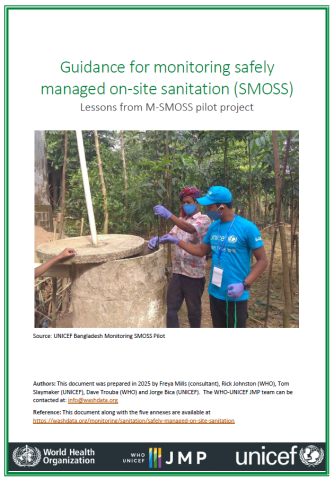
This document summarizes emerging best practice monitoring methods to inform the monitoring of safely managed on-site sanitation (SMOSS). Although globally more people use on-site sanitation services than have sewer connections, there are major gaps in monitoring SMOSS.
Estimates for excreta that were emptied and treated off-site are only available for 2% of the global population using on-site sanitation. The lack of data on SMOSS presents a major constraint for national and global monitoring of SDG indicator 6.2.1a: the use of safely managed sanitation services, as well as for monitoring of SDG indicator 6.3.1 on wastewater treatment.
This document describes the global indicators for SMOSS, proposes core questions and tested methods to collect data and proposes steps to strengthen national monitoring systems. While there is not one standard approach to monitoring SMOSS, this document consolidates methods and findings from the JMP monitoring SMOSS pilots as well as experience from global and national monitoring. This guidance aims to support national governments, WASH sector stakeholders, and others looking to improve national monitoring of SMOSS, to build from existing knowledge and address the many outstanding monitoring gaps. This document is accompanied by WHO Academy summary and technical online self-paced training courses and tools available at https://washdata.org/topics/sanitation/safely-managed-on-site-sanitation.
The document links to a series of annexes which provide additional details on indicators, core and expanded questions and tools for designing monitoring systems to collect data for SDG 6.2.1.
A. Global indicators for monitoring SMOSS
B. Data collection – Household questionnaire
C. Data collection – household sanitation inspections
D. Data collection - Service authority and service provider surveys
E. Analysis to inform national estimates for SDG 6.2.1